
Tuggerah
Book an appointment
Biomechanical Assessment

Blueprint Podiatry excels in advanced Biomechanical Assessment

We use our Zebris treadmill and unweighting harness to analyze and treat conditions impacting mobility and well-being.

Biomechanical Assessment

Biomechanical assessment in Tuggerah using force-platform gait analysis and objective strength testing. Blueprint Podiatry helps Central Coast patients move better.

A biomechanical assessment is a structured examination of how your feet, legs and lower body move and load during standing, walking and running. By measuring your movement objectively, our podiatrists can identify the mechanical factors that may be contributing to pain, recurring injury or reduced performance — and build a plan to help manage them.

At Blueprint Podiatry in Tuggerah, every step you take has an impact on your wider musculoskeletal health. Understanding your unique biomechanics is often the first step towards lasting relief and better movement.

What is a biomechanical assessment?

Your biomechanics describe the way your joints, muscles and soft tissues work together as you move. Small differences in alignment, strength, range of motion or gait pattern can place uneven load on the feet, ankles, knees, hips and lower back. Over time, this may contribute to pain or injury.

A biomechanical assessment aims to understand why a problem is occurring, rather than only treating where it hurts.

Common reasons people seek an assessment

  • Chronic foot or ankle pain
  • Knee pain or instability
  • Hip or lower back pain
  • Recurring or unexplained sports injuries
  • Plantar fasciopathy (heel pain)
  • Shin splints
  • Flat feet or high arches
  • Concerns about posture or alignment
  • Pre- and post-operative planning
  • Improving athletic performance

How does Blueprint Podiatry assess your biomechanics?

Our podiatry team takes a measurement-led approach rather than relying on visual impressions alone. Each of our three registered podiatrists holds a Bachelor of Podiatry, training in Foot Mobilisation Therapy, and certification as a Level 1 Running Coach — so gait and running analysis is genuine clinical expertise here, not an afterthought.

A typical assessment may include:

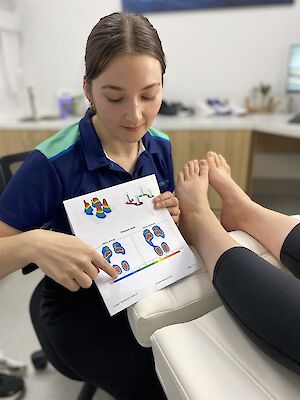
  • Force-platform gait analysis using our Zebris instrumented treadmill, which measures plantar pressure distribution, ground-reaction force and centre-of-pressure while you walk and run — providing objective dynamic data, not just observation.
  • Objective strength and range-of-motion testing with a VALD dynamometer, giving reliable baselines to guide rehabilitation and track your return to activity.
  • A clinical history, joint and muscle assessment, and footwear review.

Where appropriate, our findings may inform treatment options such as custom orthotics (3D scanned and 3D printed in-house at our Tuggerah clinic), foot mobilisation therapy, a tailored strengthening program, footwear advice, shockwave therapy or dry needling.

When should you seek help?

Consider an assessment if you have pain that persists beyond a few weeks, injuries that keep returning, noticeable changes in how you walk or run, or if you're preparing to increase your training load. Sound mechanics matter across the whole kinetic chain — even research into structures like the calcaneal (Achilles) tendon highlights how mechanical load and repair influence recovery [1].

Citations

[1] Adames MK et al. Biomechanical comparison of shoelace suture technique for repairing calcaneal tendon. Injury 2023. https://pubmed.ncbi.nlm.nih.gov/37890290/

Medically reviewed by Matt Shanahan, registered podiatrist (AHPRA POD0001603396), Blueprint Podiatry.

Last reviewed: 21 June 2026.

Practitioners offering this service

Our clinics offering this service

Frequently asked questions

What should I bring to my biomechanical assessment?

Please bring the shoes you wear most often (including any sports or running shoes), comfortable clothing you can move in, and any relevant scans or referrals. This helps our podiatrists assess both your movement and your footwear.

Do I need a biomechanical assessment to get custom orthotics?

Generally, yes. Understanding how you load and move helps us decide whether orthotics are appropriate and design patient-matched, left/right custom devices. Our orthotics are 3D scanned and 3D printed in-house, so there's no external-lab delay.

Can I claim my assessment through private health or Medicare?

We offer HICAPS on-the-spot private health claiming. We also accept Medicare EPC referrals (a small gap applies — this is not bulk billed) as well as DVA and NDIS. Our reception team is happy to help you understand your options.

Ready to meet the team and make an appointment?

Online Booking is the quickest most convenient way to secure the time, location and practitioner you want. Want to meet your Practitioner first? Select Meet the Team to get to know our amazing Podiatrists.

Book an appointment